2022-2023 Transfer Program Audit Report FALL
DEPT.: Sociology/Anthropology
SUBMITTED BY: Suzanne Reilly & David Holliway
2022-2023 Transfer Program Audit Report FALL
PROGRAM QUALITY – TRANSFERABILITY:
- Discuss how your department determines that the courses offered are still viable and
relevant?
All Sociology and Anthropology courses fulfill critical distribution requirements for the statewide
Direct Transfer Agreement (DTA). - Does course curriculum satisfy DTA requirements? How do you know? What needs to change?
Yes. - Please construct a table to show all courses offered by your department and how they
transfer to CWU,
EWU, and WSU. Identify any courses that do not transfer or transfer as general electives.
| BBCC | CWU | EWU | WSU |
| ANTH& 100: Introduction to Anthropology (5) |
ANTH 107: General Anthropology (5) |
Lower Division Social Science Elective |
ANTH 101: Introduction to Anthropology (Diversity) |
| SOC&101: Introduction to Sociology (5) |
SOC 107: Principles of Sociology (5) |
SOCI 101: Introduction to Sociology (5) |
SOC 101: Introduction to Sociology |
| SOC&201: Social Problems (5) |
SOC 101: Social Problems (5) |
SOCI 263: Social Problems (5) |
SOC 102: Social Problems |
| SOC 204: Gender and Power (5) |
SOC Lower Division Transfer Elective |
University Lower Division (Diversity) |
WGSS 101: Gender & Sexuality Studies (Diversity) |
| SOC 220: Marriage and Family (5) |
SOC Lower Division Transfer Elective |
SOCI 370: Sociology of the Family (5) |
SOC 251: Sociology of Sex and Relationships (Diversity) |
4. If some of your courses are not transferring to universities as you expected, what information and/or assistance do you need to help you resolve these transfer issues?
Our efforts should always be toward making our courses be accepted as comparable credit
at recipient
institutions. Some of our courses are transferring directly and even being counted
as diversity
requirements at recipient universities. As faculty we provide all essential information
to aid in
articulation efforts and ask the administration to intercede on our behalf when students
are not given full
recognition for the credits they earned at our institution.
ADVISING RESOURCES:
5. Please review your department catalog and website information. Is the information current and accurate? What changes need to be made or would you like to make to better assist students? Submit catalog changes with this report. If you need to make changes to the bigbend.edu website, you will need to submit a work order in the Kace system (where BBT and Advising Map work orders are submitted) in the Communications area to arrange for website changes.
In the catalog:
- My name is incorrect on page 165. My name is Suzanne Reilly, not Suzanne Richards.
- We need to review the relevance of the social work course based on current offerings and future plans.
- On page 255, the social work class is referred to as SOCW 110: Introduction to Social Work.
On the website:
- There is a class listed as SOC 273: Introduction to Social Welfare.
- On the Sociology page, SOC 204: Gender and Power should be listed as a recommended premajors course.
- The career possibilities link needs to be addressed. We could easily put both the American Anthropological Association (https://americananthro.org/) , the American Sociological Association ( https://www.asanet.org) and the Society for the Society of Social Problems (https://www.sssp1.org/) website addresses on our program maps. However, it has never been explained to us why, but we no longer have specific program/advising maps for the Social Sciences. The Social Sciences were collapsed and included into one advising map, the AA&S DTA.
- A program/advising map could be included on the website to assist students who are interested in perusing careers in Anthropology and Sociology.
6. Has your department developed advising resources/maps to assist students majoring in your discipline or in a related field? Please describe these advising resources/maps. Have you considered developing transfer resources (such as four-year advising maps) for students intending to transfer to CWU, EWU, or WSU and major in your discipline or in a related field? How could BBCC assist you in developing these resources?
We have had Advising maps for each Social Science in the recent past, but as mentioned in the prior question, our department's advising resources/maps were combined into one AA&S DTA map and we were not included in that decision, so we have no idea why we do not have individual maps for the specific Social Sciences. Our department would look forward to working with Advising to develop these maps to assist students. Making transfer guides more transparent for students would enable us to give students better advice when they know where they want to go.
We now advise Social Science majors would be advised to complete the DTA, outlined on pages 41-50 of the 2022-23 Catalog. However, the “map” provided there gives students an overly generalized view of how to develop a plan that will help them become major ready upon transfer. Students need to know that fulfillment of distribution requirements is related to general education, but taking Sociology, Anthropology and related social sciences needs to be intentional for a student interested in majoring in these. Our department is interested in helping students transfer with a deep knowledge of the theory and applications of our field so they can continue to be successful at the transfer institutions where faculty may not be as supportive or focused on learning as we are here at BBCC.
SCHEDULING:
Please review your course offerings and enrollments over the last three years as well
as the FTE information for your department.
7. Discuss how the scheduling for your courses has been evaluated. Describe how scheduling has been altered or maintained to meet the needs of other programs or populations of students.
Our strategy for scheduling is to be as present as possible throughout each day at separate times and through different modalities including face to face, hybrid, and completely online synchronous and asynchronous formats. We do attempt to maximize enrollment in all our courses and our faculty have great flexibility in teaching what and when we teach but often our decisions are based on collaborating with the needs of other departments and more recently, to accommodate Running Start and other high school students. This year we have offered SOC& 100 at times that allow workforce students to take them. Suzanne Reilly taught SOC& 101 from 4:20-5:25P during Winter Quarter. We are a small department and negotiate amongst ourselves when, and what courses we will offer and who will do ongoing assessments needed for each of our courses to ensure we continue to maximize student learning.
8. Has this program considered providing other options for offering the program content;
such as, online, hybrid, nights, competency-based, weekends, etc? Discuss.
a. If yes, what is being considered and why?
b. If no, is this something that should be considered and why/why not?
Yes, Sociology and Anthropology have been offered in online and hybrid modalities. SOC& 101 has been offered in the late afternoons to attract workforce students. If there is interest from students, night classes or classes in Quincy should be considered.
9. Discuss future plans for annual scheduling based on this audit review. Please share how annual scheduling will need to change to meet future student needs as well as any department needs you have identified with respect to instruction.
Over the past three years, faculty have worked diligently to (a) add new classes in Sociology, (b) gain diversity designations for the classes, and (c ) offer classes in a format and time slight that is attractive to students. The impact of these changes is clear from the FTE data. Sociology sections have grown over AY19 and average seat counts continue to rise as students find value in the new courses and ability to use Sociology to fulfill their diversity requirements.
| AY | Program | Average | Students | Sections |
| 20 | ANTH* | 26.0 | 78 | 3 |
| 21 | ANTH* | 27.3 | 82 | 3 |
| 22 | ANTH* | 17.3 | 52 | 3 |
| 20 | SOC* | 24.4 | 341 | 14 |
| 21 | SOC* | 28.8 | 375 | 13 |
| 22 | SOC* | 29.4 | 412 | 14 |
TRANSFER PARTNERSHIPS:
10. Provide information about how this department is involved in building and/or maintaining
specific partnerships/relationships with one or more of our three transfer institutions
(WSU, CWU, EWU). List and identify the partners/transfer institutions, describe the
relationships that have been established, and what is planned for the future to establish
better connections with our transfer institutions.
Historically, we had a great working relationship with a professor of anthropology at Central. For several years, twice a year we took students on a field trip to visit on going classes, view their small anthropology museum on campus and participate in a class on using atlatls. This professor left and an earnest attempt to continue this connection was lost because seemingly other Anthropologist at CWU were not as interested in collaborating with us. We currently do not partner formally with transfer institutions specific to anthropology or sociology because there is not any specific effort for students to enter these institutions with junior status in our field. Development of a student friendly map to completion that takes a student through the DTA in this manner AND aids them at WSU, CWU, or EWU would be a tremendous asset with recruitment value by the recipient institution. We are open to, willing and eager to work with a department at the transfer institution if they are interested in articulating our program in such manner.
CAREER GUIDANCE:
11. How does your department provide career counseling with information on employment
trends, wages, and opportunities to assist students plan their education? What resources
do you need to assist you in providing career counseling information to your students
and advisees?
We regularly meet with our students as well as advisees to discuss careers in Sociology, Social Work, and Anthropology. We attend Explore Big Bend Events to provide information about our departments to attendees. As part of our regular course work we do discuss some the requirements needed to become an anthropologist or sociologist, and in several videos, anthropologists explain their personal journeys in becoming anthropologists and anthropologists. In one of our courses, the Anthropology texts contains explicit stories about how certain individuals became anthropologists and why. We do discuss possible career paths and the probability that graduate school may be required to continue professional development in a chosen Social science profession.
2022-2023 Transfer Program Audit Report WINTER
PROGRAM QUALITY – INSTRUCTION:
1. Select all methods that are used by your department to integrate the academic knowledge
and skills of your students and ensure that they are taught with the same coherence
and rigor as all other students.
Please provide short descriptions of each selection.
☐Contextualized Instruction
☐Team-Teaching
☐Math-First Initiatives
☐College-Level Core Curriculum
☒College-Wide Student Learning Outcomes
☐STEM Initiatives
☐Tutoring
☐Flipped Classrooms
☐Just in Time Support Instruction/Accelerated
Learning
☒Active Learning/Student Engagement
Techniques
☒Project Based Learning
☐Industry Standardized Tests/Exams
☐I-BEST Programs
☐Other (Please describe.)
PROGRAM QUALITY – STUDENT ACHIEVEMENT DATA:
Please use the student achievement data provided to discuss and review how successful
students are within your classes. Please use the Course Success Rates tab in the About
BBCC Tableau workbook and the Course Letter Grades Tableau workbook to gather the
data for the courses in your department. These workbooks can be found on the Institutional
Research & Planning page in the Portal.
2. Are there certain classes with student success rates below 75%? Within your courses, what achievement gaps do you observe within underrepresented groups taking your courses? Which of these gaps are you focusing your efforts on and what are your next steps? How does this student achievement data intersect with your assessment efforts?
The average success rates for all Sociology and Anthropology courses is comparable
to institutional success rates. The past two years, success rates for Anthropology
100 have slipped to 73% (AY22) and 77% (AY23). Assessment of PO4/5 in these same years
can inform where students struggle and help us
modify instruction.
PO4 Students will be able to recognize or articulate personal/interpersonal aspects of, or connections between, diverse cultural, social, or political contexts.
PO5 Students will be able to solve problems by gathering, interpreting, combining
and/or applying
information from multiple sources.
In Sociology, the two largest ethnic representations (white and Hispanic) track very well with each other. Gaps emerge every other year for African-American students and others, but the year to year variability due to small numbers of students makes this difficult to characterize. Sociology has been focusing on PO5 to inform curricular improvements.
3. Please describe what you are doing as a department to increase student success, especially within courses that exhibit low success rates or that indicate achievement gaps exist for some student groups? How are you closing the loop to see if your efforts have made improvement or not? What further steps do you plan to pursue?
Student success in Sociology and Anthropology is consistent with success rates in other BBCC classes when broken out by race, class, gender, and economic need status. Within the departments’ offerings, white and Latinx students are comparably successful.
Demographics
| Population | White | Latinx | RS | Economic Need |
| All | 40.0 | 37.1 | NA |
We are unable to ascertain the population breakdowns of our department using the dashboards provided. Use of this information would be helpful in determining if we are providing appropriate access with which to compare success.
Success Rate (F/W, AY20-23)
| Population | White | Latinx | RS | Economic Need |
| All | 80.0% | 75.3% | 81.% | 79.0% |
| SOC/ANTH | 83.5% | 83.5% | 88.0% | 80.5% |
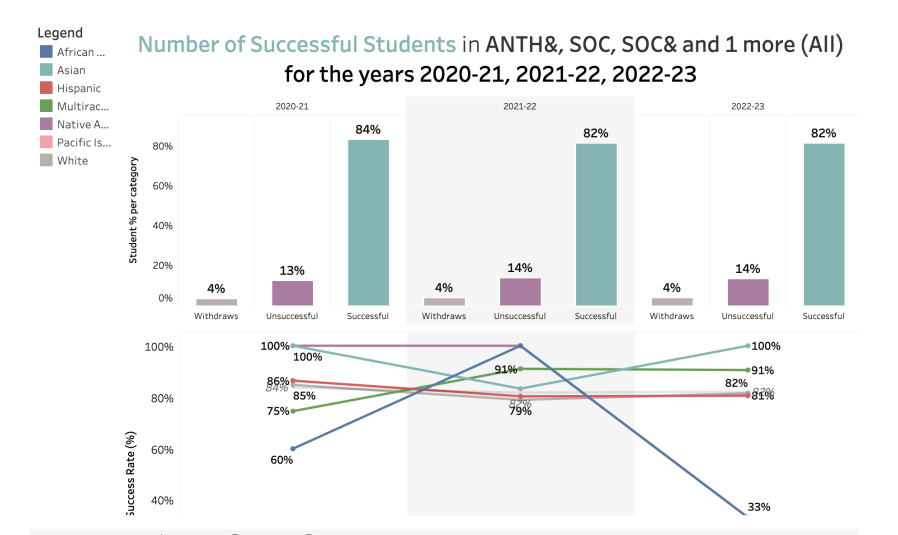
The Division faculty are very collaborative in attempting to address equity gaps.
New courses and
approaches are specifically tailored to bring a culturally responsive, accepting,
and affirming approach
to learning Sociology and Anthropology and to allow lived experience to be a lens
through which
students can learn theoretical constructs.
4. Are there additional insights you have observed when looking at student grade data within courses? Please highlight one or more of these observations.
We feel our instruction across the social sciences is strong given our consistent success rates across different course sections, different quarters, different modalities and across the last several years. We are committed to professional development and we continue to question our instruction, learn from and with our students and make adaptations when the need may arise.
PROGRAM QUALITY – ASSESSMENT PLAN:
5. Please review your department’s 7-Year Plan and Course Crosswalk for accuracy and completion. Does the course crosswalk accurately reflect the courses offered by your department? Are all courses offered being assessed once within a seven-year span and are all program outcomes included within your department’s courses assessed at least once during the plan. Update your plan to include seven years moving forward from this year. Submit your updated plan along with the Winter Quarter Program Audit Report.
The course crosswalk does not currently accurately reflect the courses offered by our departments. Our department has recently begun offering two courses that have not been offered in a while and so those two courses Soc 204 and Soc 220 will need to be added to the crosswalk.
LAB FEES:
6. Does your department maintain a lab fee account?
- If yes, please answer the remaining questions regarding lab budgets.
- If no, please skip the remaining questions regarding lab budgets.
No.
7. Is the lab account balance adequate to cover consumable expenses?
- If no, have fees been reviewed? Why/why not? What is needed to ensure consumables
are covered.
Discuss. (Should this discussion be used to request a fee increase?) - If yes, do fees need to be reduced? Discuss.
8. Is the lab account balance adequate for purchasing needed equipment/technology updates?
- If no, do fees need to be increased to help support these? What is needed and what will it cost? How much do the fees need to increase? Discuss. (Should this discussion be used to request a fee increase?)
- If yes, what will be purchased and when?
TECHNOLOGY:
9. Does your department have the technology available that is needed within courses to prepare students for transfer? Discuss.
No. Since COVID, many students are interested in taking more classes online. Since we are offering more online classes, it would be to our benefit to have cameras in our face-to-face classes to record lectures and student engagement to make available for the online students. There used to be a camera in 1601 that we could use to record face to face classes, but the system has not been maintained nor updated.
10. Review your current equipment/technology inventory. Are there equipment/technology purchases that you think that you may need within the next three years. Please discuss equipment/technology where replacement/update is needed or where technology/equipment is obsolete. Have you planned for these purchases within your lab fee account, if you have one? How do you plan to budget for these purchases?
We are woefully under-resourced when it comes to technology and technology support.
INTERNAL PARTNERSHIPS:
11. Provide information about how your department is involved in building and/or maintaining specific internal partnerships/relationships. Briefly describe the partnerships you have been working to develop and what the outcome(s) of those partnerships has been. What are you considering or planning to do in the future?
We currently do not have formal internal partnerships/relationships. We do communicate regularly with our Criminal Justice professor and we share many of the same concepts with our course yet we approach them from different perspectives. For example, prison, addiction, gender inequality, the purpose of policing, the death penalty, economic inequality, and socio-historical context are issues we study and learn about, perhaps we can be more intentional in our inter-course connections in the future.
2022-2023 Transfer Program Audit Report SPRING
PROGRAM QUALITY – ASSESSMENT:
We are required by our accrediting body, the Northwest Commission on Colleges and
Universities (NWCCU), to document our assessment of student learning activities. Specifically,
we are expected to assess student learning in our programs, to design and implement
changes in our teaching intended to improve student learning, and to use further assessment
of student learning to measure the impact of those changes on student learning.
Please review the assessment work you did over each of the past three years and then respond to these questions.
1. Based on your prior assessments, what were the issues (problems) that you were trying to address in an effort to improve student learning?
Based on prior assessments, some problems that we were trying to address were students’ communication skills.
2. What changes did you make in your instruction and/or program to address the problems identified in the question above?
One way to address some of our concerns is to have more explicit discussion on writing strategies to accomplish the course workload, working on clarifying both verbal and written instructions for assignments, giving student time within each class to discuss various responses to in-class and online discussions.
3. After implementing your changes, what impact did the changes have on student learning? How do you know/What did the data tell you?
4. What are the implications for your academic program or department? (What are your next steps now?/What will you do to close the loop?)
More writing instruction and more in-class student-led discussions.
PROGRAM QUALITY – OUTCOMES:
5. Did your department invest in technology or equipment used to improve content delivery or student performance? If so, please describe the purchase and the impact it has had on content and/or student performance.
No.
6. Please provide examples of any innovative projects, initiatives, or state-of-the-art equipment undertaken in the last year. Please describe and include links to any social media posts and/or press/media coverage, if applicable.
In SOC&101, students are identifying social problems in their communities, researching them and presenting on how these social problems affect people (case studies) and ideas for addressing these social problems.
In ANTH&100 students conduct a Mini-Ethnography (participant observation) studies where they visit a site in their community and simply, sit, observe, take notes and then write up their impressions of what they observed. As well, students in anthropology do a one-week Garbology study to learn of the various ways we consume stuff and learn about how we discard our daily waiaste products.
7. What was the most successful or noteworthy development with respect to program quality and/or program improvement this year?
Rewriting MCOs to reflect a more contemporary understanding of sociology and offering classes that are in the catalog but haven’t been offered in a while. Two new courses, Soc 204 Gender and Power, and Soc 220 Family and Society have been recreated and are currently being offered.
8. What were the most significant challenges (e.g. funding, enrollment, performance, staff retention or turnover, equity, etc.) encountered in the last year? How could BBCC assist in addressing these challenges?
Lack of BBCC resources. Bookstore closing and inability for one person to address the entire campus textbook concerns, lack of canvas support, lack of tech support, lack of library resources, for example documentaries available for online students.
It is difficult to operate technology in the classrooms, students need more language support, help with AI issues and more confidence in using the various platforms we use at BBCC>
FACULTY/STAFF PROFESSIONAL DEVELOPMENT:
9. Please provide brief descriptions and dates of professional development in which you and members of your department have participated in the last year.
One faculty member was fortunate to participate in the AAA (American Anthropological
Association) annual meeting in Seattle, November 9th – 11th, 2023. As well, the same
faculty member was awarded a faculty excellent award (FEA) in support of attending
this conference.
We are interested in attending American Sociological Association (ASA) and other AAA
conferences. There are state-wide chapters for these associations but they have not
been as active as they were prior to Covid.
10. What was the most successful or noteworthy development with respect to faculty/staff retention and professional development this year?
Attending the AAA meeting and the PDU model allows faculty to customize professional development for themselves.
11. Select the methods employed to provide professional development opportunities
for faculty/staff. Provide a brief description of each selection.
☐New Instructor Conference/Boot Camp
☐Deans Academy
☐Return-to-Industry
☐Faculty Peer Mentoring
☐Professional Development Days
☐Distance Learning Training
☐X Technology and E-Learning Tools
☐Data and Assessment Workshops
☐X Subject Matter Conferences
☐ X Other
K-12 COMMUNITY PARTNERSHIPS:
12. Does your department provide opportunity for College in the High School or CTE Dual Credit with area high schools?
- If yes, list the classes and the schools.
- If yes, could these offerings be expanded? How?
- If no, is this an area that can be developed? How?
13. Provide information about how your department is involved in building and/or maintaining specific external partnerships/relationships with K-12 schools and the communities in our service district. What K12 partners are you working with and what communities are you working in? What was the most successful or noteworthy development with respect to high school partnerships? What are you considering or planning to do in the future?
Sociology and Anthropology contain a significant number of Running Start students. Our courses are typically not available for CiHS because HS faculty lack the appropriate credential (Masters in SOC or ANTH). Aside from Social Work, courses do not fit CTE pathways. Accordingly, our primary emphasis to date has been on serving Running Start students well and increasing their knowledge of and interest in our disciplines. Sociology and Anthropology serve communities well by engaging our students in projects and learning opportunities in which students reflect on their families and communities as situated in culture and society. Students in our classes learn new skills and tools that allow them to engage productively in a pluralistic society.
14. Please describe any outreach events you have participated in as a department. What plans do you have in the future to participate in outreach events with our service district communities?
Sociology and Anthropology faculty participated in advising. During COVID, faculty visited every major community in our service area and recorded lectures on location, recognizing and representing where students at BBCC come from, where they were learning remotely, and how those communities matter in the context of a sociological lens.
PROGRAM AUDIT SUMMARY/REFLECTION:
15. What are some key things you have learned about your program/department as you completed the program audit?
We are a small but powerful department; we offer as wide a variety of courses, 2 newly developed by a tenured faculty member; we use various teaching strategies within our courses; our courses are popular in all modalities; our courses resonate with other course content across the campus; we are committed, excellent educators assisting students in learning some of the basics of Anthropological and Sociological thought; we prepare students to transfer on to University while also helping students to learn the “culture of becoming a college student.” Given our small faculty in number, we feel we are meeting the various needs for various student concerns.
16. What are the primary actions you have taken over the past three years to improve student outcomes in your program/department? Why were you focusing on these things? How do you know you are making progress?
17. We have increased the number of new content courses offered giving students a wider collection of course to take for transfer and to integrate with their other social science courses. Historically we have had only one Sociology and Anthropology professor so they taught courses they were qualified to offer, but with a new tenured faculty, they have expanded courses availability and variety. We will know more in the next audit the extent to which our new courses have expanded ad motivated students to begin and continuing studying Anthropology and Sociology.
18. What goals do you want to accomplish over the next three years to improve your program/department?
Faculty in our broader division are doing the best they can to build cohesion, interest, and equitable student success. Even as we work to build pathways and options for students in our disciplines, there is a growing recognition that we cannot do this alone. Issues, such as helping students succeed when the English skills are getting in the way of their ability to communicate what they are learning, requires collaboration across academic and student support areas, and administrative support.